

At the half way point of the season, analytics is telling the Lakers they’re a statistically bottom-10 team in four critical areas needed to play winning basketball: 3-point makes, field goal attempts, rebounds, and blocks.
Right now, the Lakers rank 23rd in 3-point shots made, 29th in field goals attempted, 26th in rebounds collected, and 27th in shots blocked. These are the four key areas the Lakers need to upgrade before the trade deadline. With offense-first stars, it’s no surprise the Lakers ranked 25th on defense. The shock was when the best the expected juggernaut Doncic, James, and Reaves offense could do was the 9th best offense with a -9.8 net rating.
The Lakers need a total roster makeover right now and not just one or two new players to be a legitimate contenders. They may also need to expand their draft capital, trade James or Reaves, and find a new center rotation.
They need volume 3-point shooting, positional front court size for better rebounding and rim protection, and more speed and athleticism to help upgrade their point of attack, offensive rebounding, and transition games.
The Lakers realistically have two promising opportunities to make major strides towards totally rebuilding the team’s starting lineup and rotation around transcendent 27-year old superstar point guard Luka Doncic.
The Lakers’ first opportunity to rebuild their roster would be via trades before the trade deadline and their second opportunity would be via signing multiple unrestricted and restricted free agents next summer.
Let’s look closer at the franchise-defining questions Lakers must answer and the strategies they need to successfully execute a roster makeover via mega trades before the deadline and signing of free agents next summer.
Lakers’ Franchise-Defining Questions
…
The Lakers need to answer several franchise-defining questions before they can properly plan and execute specific strategies and tactics to take advantage of the looming trade deadline and next summer’s free agency.
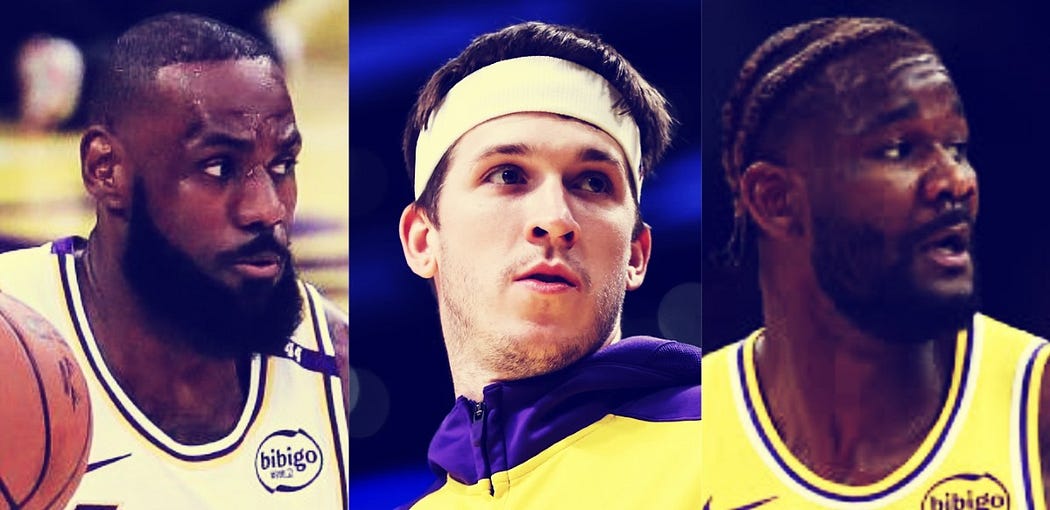
Heading the Lakers’ list of franchise-defining questions is what to do with LeBron James, Austin Reaves, and Deandre Ayton. Unless things change, the Lakers plan to allow LeBron James’ contract to expire at end of season.
LeBron has 4 realistic options. He could retire, re-sign with the Lakers, sign with another NBA team, or waive his no-trade clause and request a trade. Barring winning #18, this season is most likely LeBron’s last as a Laker.
What to do with Austin Reaves is Lakers’ next franchise-defining question. Austin dramatically elevating his game to an All-Star level this season has ended most concerns if he and Luka could be a championship backcourt. Despite the redundancy in Doncic’s and Reaves’ games that makes building a two-way starting lineup challenging and the risk of overpaying or losing him for nothing to free agency, the Lakers are not going to trade Austin.
Finally, the Lakers have reached the point where they know they must move on from Ayton. LA needs a defense-first center to protect the rim but trading Deandre and his $8 million player option will be challenging.
Ideally, the Lakers must embrace analytics and build a center rotation that prioritizes protecting the rim and controlling the boards on defense and spacing the floor with 3-point shooting and vertical lob threats on offense.
Under Mark Walter’s ownership, LA has made franchise-defining decisions to allow LeBron James’ contract to expire, to pair Austin Reaves with Luka Doncic going forward, and to move on from Deandre Ayton at center.
Lakers’ Trade Deadline Priorities

…
While most pundits think the Lakers’ greatest need is for an elite starting 3&D wing like Herb Smith, the analytics are saying the quickest and easiest upgrade LA can make at both ends is replacing Deandre Ayton at center.
While some changes can wait until summer, it’s obvious the Lakers will not be a true title contender until they have a starting center to protect the rim, control the backboards, and space the floor horizontally and vertically. Lakers’ top priorities at the trade deadline should be to expand their draft capital so they can also trade for a modern starting center to protect the rim and space the floor and elite starting 3&D wing to play small forward.
LA could expand their tradable draft capital from 1 to 4 first round picks by trading their 2031 unprotected pick for three protected picks from OKC, including a 2027 pick that would let them trade their 2026 and 2028 picks.
That would allow the Lakers to trade their 2026 and 2028 picks plus 2 of the 3 first round picks they got from OKC while keeping a 2027 first round pick. This would give the Lakers 4 first round picks to trade at the deadline.
Ideally, the Lakers would use these 4 picks as sweeteners plus $65 million in matching salaries to trade for new starting and backup centers and new starting small forward before the looming February 5th trade deadline.
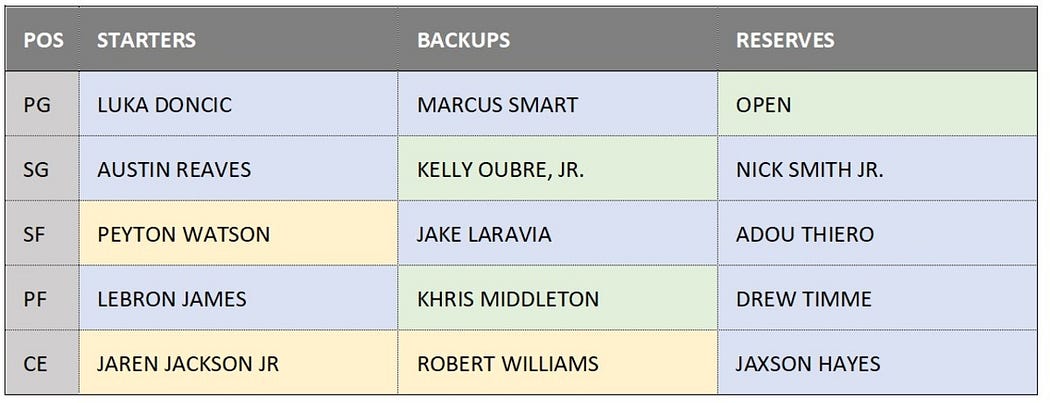
For example, LA could trade Ayton, Kleber, Vincent, Vanderbilt and 3 picks to Memphis for Jaren Jackson Jr., Knecht and 1 pick to Denver for Peyton Watson, and Hachimura to Portland straight up for Robert Williams.
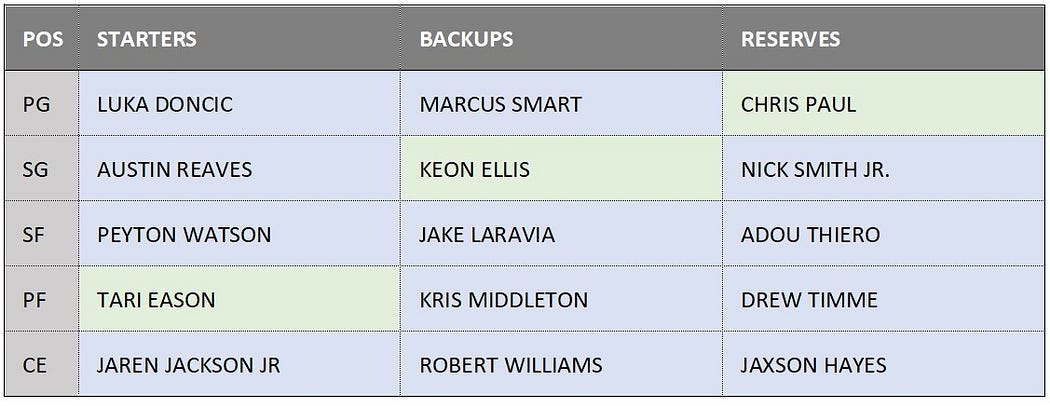
That would leave the Lakers with a starting lineup of Luka Doncic, Austin Reaves, Peyton Watson, LeBron James, and Jaren Jackson Jr. and enough cap space under the second apron to sign buyouts Middleton and Oubre Jr.
Lakers’ Summer Free Agent Frenzy
…
After deadline trades for a starting center, starting small forward and backup center, the Lakers could head into next summer with a free agency war chest of up to $100 million for their own and other teams’ free agents.
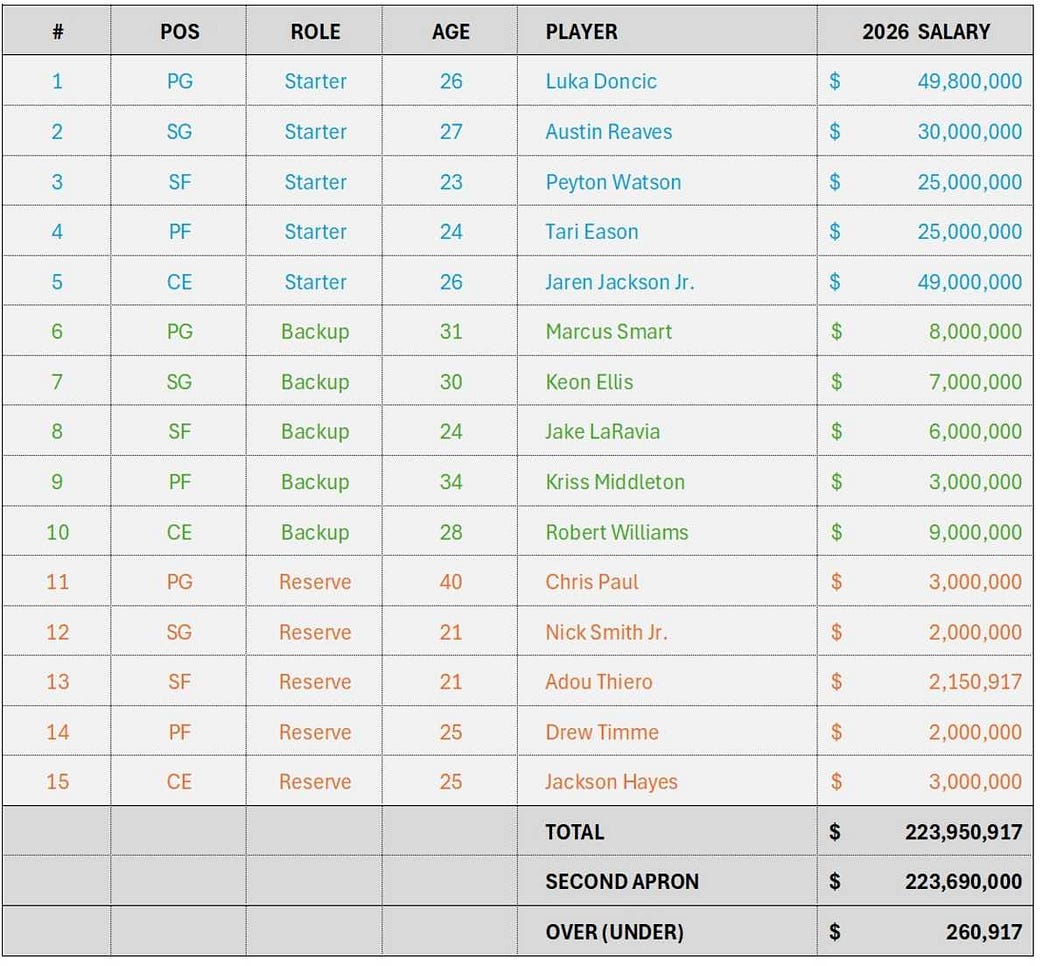
Lakers will use $45 million in cap space to give their free agents raises: Reaves to $30 million, Watson to $25 million, Williams to $9 million, Smart to $8 million, Hayes to $3 million, Smith Jr. and Timme to $2 million/year.
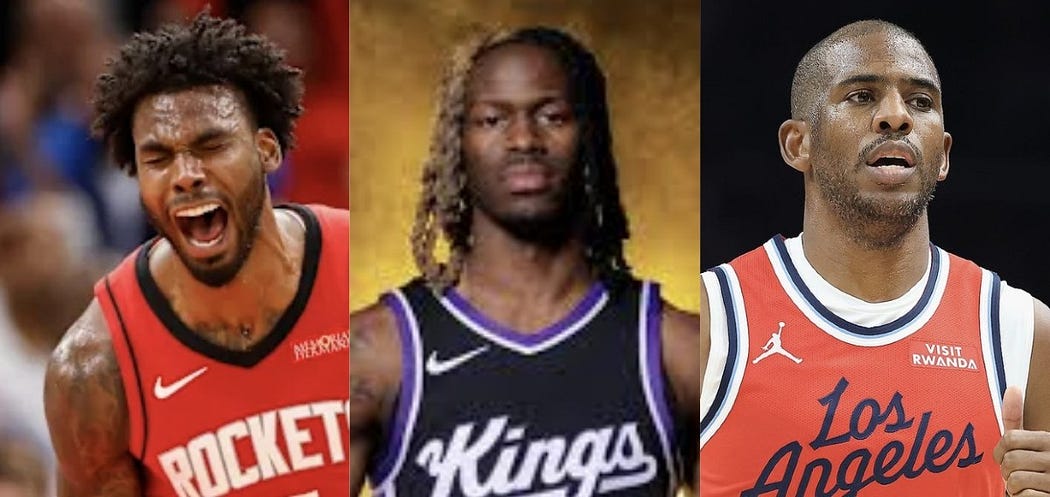
During the summer free agency, they will use an additional $35 million in cap space to sign Houston’s Tari Eason for $25 million per year, Kings’ Keon Ellis for $7.0 million per year , and Clippers’ Chris Paul $3 million per year.
The Lakers total payroll for the 2026–27 season will total $224.0 million, which is $260.9 thousand under the $223.7 million second apron. Starters will earn $178.8 million, backups $33.9 million, and reserves $12.2 million.
One policy the Mark Walter Lakers are likely to follow the same as the Mark Walter Dodgers is they will paying top salaries for every position but will limit the length of contracts to retain maximum optionality and versatility.
Mark Walter’s Dodgers treat MLB luxury taxes as necessary investments. The Lakers could open $13 million more in cap space by hard capping team at the $223.7 million second apron instead of the $210.7 million first apron.
The second apron is the final spending limit franchises can go into before facing severe team-building penalties. Those penalties are so competitively severe that the second apron essentially acts like the NBA’s hard cap.
Mark Walter’s goal is to complete the Lakers’ ownership and front office transition and finalize the total roster makeover that transforms the team into a legitimate NBA championship contender by the end of next summer.
Comments