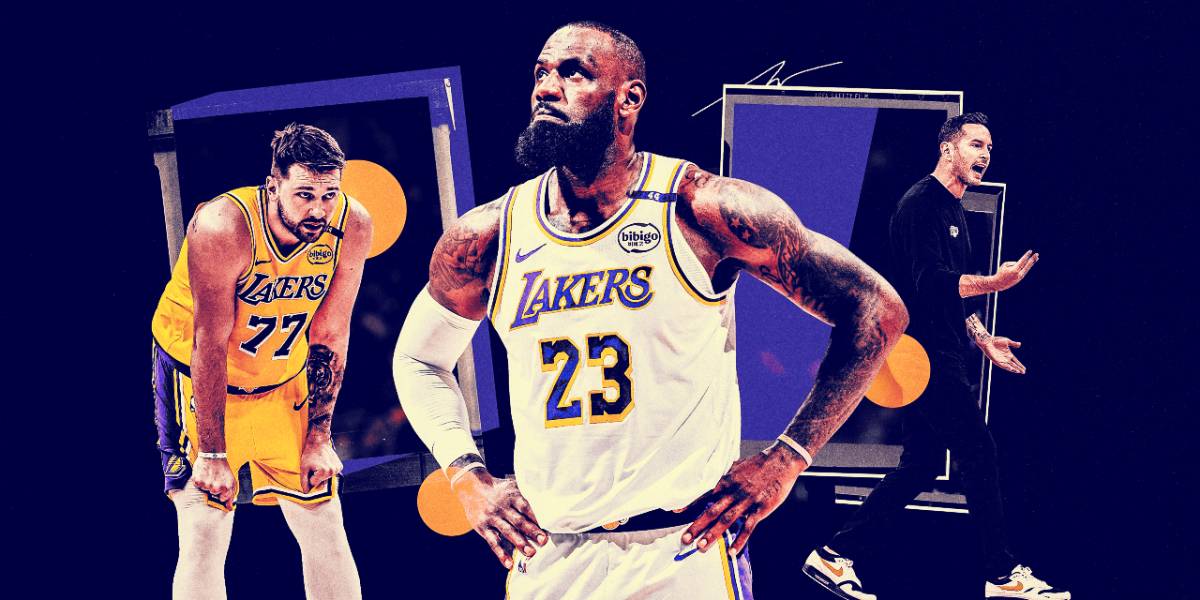

Just promoted to President of Basketball Operations for the Lakers, Rob Pelinka is already facing a franchise threatening ‘Must Win’ offseason while the NBA itself is undergoing a chaotic generational changing of the guard.
How Rob Pelinka navigates this challenge will greatly determine whether the Lakers remain among the teams who are perennial contenders for the NBA championship or slowly fade away as parity levels the playing field. Winning this offseason is going to be a difficult challenge for Pelinka because the Lakers’ major roster needs could be greater than the trading chips the team is able or willing to put on the table for major upgrades.
The main hope for Lakers exceptionalism to triumph is the heavy pressure on the Lakers from superstars LeBron James and Luka Doncic to upgrade the team’s starting lineup and 9 or 10-rotation to championship caliber.
While highly unlikely, LeBron James could decline his player option and become an unrestricted free agent and Luka Doncic could refuse to sign an extension and opt to become an unrestricted free agent after next season.
Pelinka has already said the Lakers will look much different next season and promises to be aggressive in bringing in multiple centers. The problem is everybody knows the Lakers need centers and prices will be very high.
Rob has always been a GM who focuses on getting the best deal as opposed to getting the best player. The Lakers are now facing a challenging situation where settling for second, third, or fourth best is not the smartest strategy.
Let’s take a closer look at what a ‘winning offseason’ for the Lakers this summer would look like and exactly what qualifies it as ‘winning’ as well as what a ‘losing offseason’ would look like and what dooms it as ‘losing.’
WHAT WOULD ‘WINNING OFFSEASON’ FOR LAKERS LOOK LIKE?
…
A winning offseason for the Los Angeles Lakers would surround Luka and LeBron with an elite new trio of two-way starters like Kessler, White, and Wiggins; Allen, Ellis, and Brown; or Porzingis, Ball, and Alexander-Walker.
The above photo shows three possible trios of new star role players to start alongside superstars Luka Doncic and LeBron James, including a new starting center, new starting two guard, and new starting small forward.
There are countless other combinations of elite role players who could be stars in their roles alongside Luka and LeBron. Pelinka’s job is to trade for the ‘right’ players would comprise a championship caliber starting lineup.
The Lakers’ best trade arsenal would include 2 potential future stars in Austin Reaves and Dalton Knecht, their unprotected 2031 first round draft pick, 4 first round pick swaps, and up to $60 million in expiring contracts.
The Lakers need a starting center who can protect the rim and be a vertical lob threat, a starting shooting guard who can shoot the three and shut down other guards, and a 3&D small forward who defend bigger wings.
Rob Pelinka’s and the Lakers’ challenge this summer is to put together multiple blockbuster trades to dramatically upgrade the three role players who will be starting alongside superstars Luka Doncic and LeBron James. That means replacing Austin Reaves with a legitimate 3&D point-of-attack defender, Rui Hachimura with a two-way small forward who can defend wings, and Jaxson Hayes with a defensive center who can protect the rim.
A ‘winning offseason’ for the Los Angeles Lakers would look like L.A. acquiring three new championship caliber starters to replace center Jaxson Hayes, small forward Rui Hachimura, and shooting guard Austin Reaves.
WHAT WOULD ‘LOSING OFFSEASON’ FOR LAKERS LOOK LIKE?
…
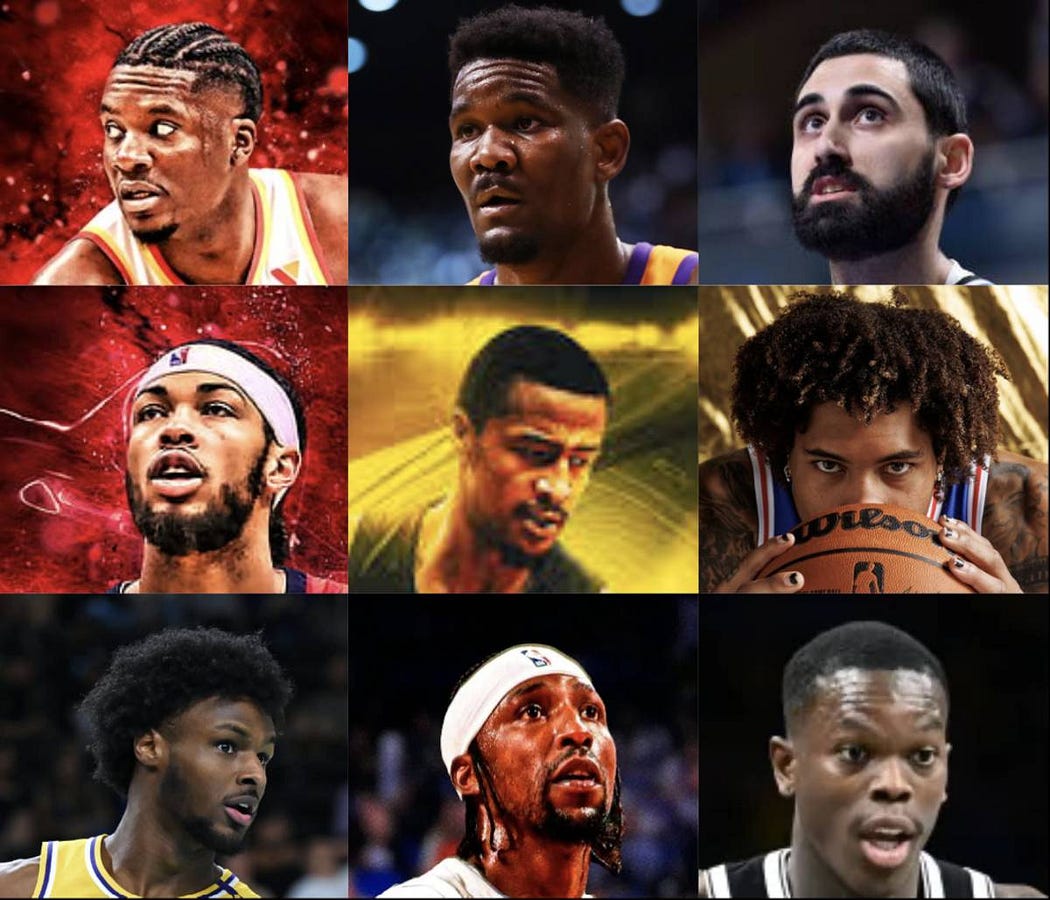
A losing offseason for the Lakers would be one where they settled for a serviceable trios of new starters such as Capella, James Jr, and Ingram; Ayton, Caldwell-Pope, and Collins; or Bitadze, Schroder, and Oubre.
The above photo shows three possible trios of serviceable new role players to start next to superstars Luka Doncic and LeBron James, including a new starting center, new starting two guard, and new starting small forward.
The problem is the resulting starting lineups, while big improvements over last season’s starters, are simply not championship caliber starting lineups. They settle for less than the best for all three of their new starting players.
The harsh reality is the Lakers will need far better players than these three trios of role players if they want to seriously compete for a championship next season as rising teams like the Thunder and Pacers get even better.
The NBA is undergoing a chaotic generational changing of the guard with new teams and stars emerging and taking over for legacy franchises like the Lakers, Celtics, Bulls, and Bucks. The times they are a-changing.
If the Lakers, for whatever reason, can’t or won’t go all-in and replace all three current starters with major upgrades, they need to acquire at least one or two championship caliber starters to have a successful offseason.
#1 priority is trading for championship caliber starting center to replace Hayes. #2 priority is trading for championship caliber starting small forward to replace Hachimura. Replacing Reaves would be #3 priority.
A ‘losing offseason’ for the Los Angeles Laker would look like L.A. settling for three new hopefully serviceable starters to replace center Jaxson Hayes, small forward Rui Hachimura, and shooting guard Austin Reaves.
For the money we can send out, the talent attached to those deals, and the draft picks we can actually trade (not swap) you’re setting an awfully high bar. I think Capella would be more than fine, he proved he has a lot in the tank last season and he fits perfectly in multiple line ups.
Some of the names mentioned are real head scratchers…Ingram? No chance in hell we can bring him back. He’s under the Giannis file (named ROTFLMAO) next to Myles Turner.
I think it’s funny/curious how just about everyone glosses over how the core of both teams in the NBA Finals have as many drafted players by their respective teams as players traded for/signed in free agency. I also think it’s funny/curios how so many people out there and on the blog jump right into “we HAVE to TRADE our way back to prosperity!!!!” when the truth is the Lakers did a pretty good job playing with a new generational talent down the stretch who was coming back from an injury and had a handful of practices to establish chemistry with his new team.
Luka all on his own, is enough to beat Minnesota, he just needed Reaves and LeBron to stay healthy: they didn’t. We needed something like the regular season version of Jaxson Hayes: we didn’t get that. Rui was solid, no notes except keep working on that rebounding, guy. DFS? Also hurt and had surgery recently. These are not small things and this team, as is, is better than it showed in the playoffs. Like I’ve said before and especially on this blog, folks just gloss right over how very much J.J. Reddick was both out-coached and panicked in the playoffs.
So, for my part, I look at this playoff exit as a lesson or 6 to be learned.
Lesson one is be better at ascertaining what talent should be allowed to walk. This is now the 3rd season where anyone with a smidge of hoops acumen can see that keeping THT instead of Caruso was as massive a failure as the Westbrook trade. maybe moreso, because Russ ended up helping us build this roster with the players he brought back. We watched THT walk out the door…right into what will be a short series of vet minimum deals before he finishes his “career” in Turkey or Greece or wherever.
Lesson two is development, development, development. It’s why I don’t think Hayes was given a very fair shake in the playoffs. He played a grand total of 42 minutes across our 5 game exit, 12 of those in game one. In 3 games he had a positive +/- and in two games (the blowouts) he had an awful negative. I don’t know how many minutes he played beyond the first half in any of those games. Point being…nobody is good in spot duty. Veterans take months to adjust to a reduced role and Jax ain’t no vet. We’ve spent a lot of time developing into what was a very serviceable regular season center and one with playoff potential, especially in certain matchups. Yes, he can get pushed around by 4 or 5 centers in the Association. So are half the guys we talk about trading for. That’s when the coach needs a better plan.
Lesson three. The coach needs a better plan. Sometimes it feels like I’m the only person who see’s how much Coach Finch utterly schooled Reddick. All you really need to look at was the desperate ploy of playing 5 guys 24 minutes but there are a lot of things to look at. Reddick seemed to go full Thibbs in that he stopped playing the guys who got him into the playoffs and focused on playing the 7 or so “best” players on the roster and watching them burn out, get hurt, and get outplayed by a fresher team. We never played Goodwin in a meaningful role vs. Minny and he was a key factor in us even making the actual playoffs and was another guy who had a positive +/- for the series (that should be taken with a grain of salt, however, all of his minutes generally came in garbage time). Point is, we went away from a lot of what worked in favor of playing the NBA equivalent of a senior citizen more minutes. And injured guys. Not smart. But a very learnable lesson.
Lesson three. trust your talent to make it work. Rick Carlisle has spoken a lot of how quickly he turned over the keys to the offense to Haliburton and really just got out of his way. The Lakers would be smart to do the same with Luka, even if it means making LeBron annoyed. I don’t think it will, after watching them both on Mind the Game they are of the same brain. Winning will smooth any wrinkles pride creates.
Lesson four. Don’t make changes to make changes. I hate it when GM’s and coaches say things like: “our roster is going to look different” or “I want an established rotation that doesn’t change” and crap that like. be flexible, adjust. There’s a series of mechanisms in place designed to encourage that kind of team-building and coaching. Rigidity is not encouraged.
Lesson five: it’s a young man’s game. If these NBA Finals aren’t proving that to you I don’t know what will.
Lesson six: do not under-value toughness, grit and competitive spirit.