-
![Profile picture of LakerTom]()
LakerTom wrote a new post
![Profile Photo]() liked this
liked this
-
![Profile picture of LakerTom]()
LakerTom wrote a new post
![Profile Photo]()
![Profile Photo]() liked this
1 Comment
liked this
1 Comment -
-
![Profile picture of LakerTom]()
LakerTom wrote a new post
![Profile Photo]() liked this
1 Comment
liked this
1 Comment-
![Profile picture of Jamie Sweet]()
I hope he can play with speed, power and health.
-
-
![Profile picture of LakerTom]()
LakerTom wrote a new post
![]() Read More
Read MoreThe Lakers might be smart to address their defensive matchup concerns versus teams who start high-scoring backcourts or twin tower front courts by giving 7 players starting opportunities in 5 different starting lineups.
There’s no question JJ Redick would be taking a foolish and unnecessary risk by embracing multiple matchup starting lineups but it could also be a great fit for this Lakers roster that solves many of their defensive issues. Besides a base starting lineup, all NBA teams already have specialized lineups to use against opponents who play small ball, have multiple elite backcourt scorers, two bruising bigs, or both. They just don’t start them.
Most NBA teams prefer to have the same 5 players as their starting lineup.
Wouldn’t it be smarter for them to expand the starters by allowing the best two defenders off the bench to start whenever the matchups call for it?
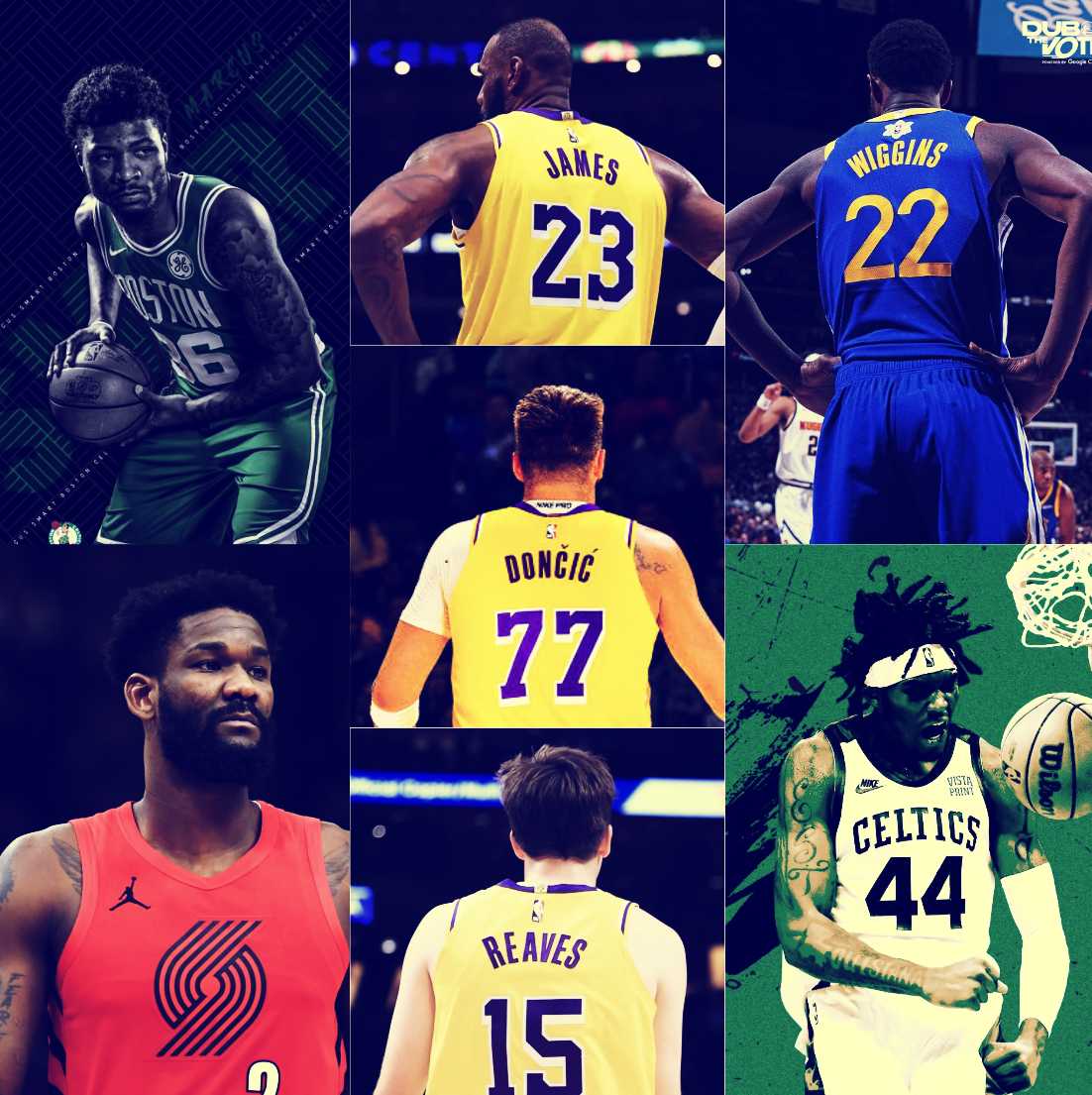
The Lakers should designate 7 starters and utilize them to create 5 lineups: a base starting lineup plus 4 custom lineups for small ball, better backcourt defense, front court defense, or both backcourt and front court defense.For the purposes of illustration, I have presumed the Lakers do out and trade Rui Hachimura, Gabe Vincent, Maxi Kleber, Jarred Vanderbilt, and Dalton Knecht for 2 elite defenders Andrew Wiggins and Robert Williams.
Luka Doncic, Austin Reaves, Andrew Wiggins, LeBron James, and De’Andre Ayton would be core starters. Normally, Marcus Smart and Robert Williams would be 6th and 7th man. On the Lakers, they also get an occasional start.The goal of the matchup starting lineup strategy is twofold. It’s designed to improve starting lineup defensive matchups and accelerate development of additional starters. If your base starting lineup works, you just go with it.
But if you’re playing against multiple high-powered backcourt shooters, you might want to start Marcus Smart instead of Austin Reaves. Against a team with two bigs, you might want Robert Williams instead of Andrew Wiggins,Bottom line, adding Smart and Williams as matchup starters would greatly improve Lakers’ defense. Following are the proposed Lakers’ base starting lineup along with four customized defensive matchup starting lineups:
…

BASE STARTING LINEUP 
SMALL BALL STARTING LINEUP 
BACKCOURT DEFENSE STARTING LINEUP 
FRONTCOURT DEFENSE STARTING LINEUP 
BACKCOURT & FRONTCOURT DEFENSE STARTING LINEUP ![Profile Photo]() liked this
10 Comments
liked this
10 Comments-
![Profile picture of LakerTom]()
Could Multiple Starting Options Give Lakers Better Defense & Matchups? The Lakers might be smart to address their defensive matchup concerns versus teams who start high-scoring backcourts or twin tower front courts by giving 7 players starting opportunities in 5 different… pic.twitter.com/sVBvkGKaqz— LakerTom (@LakerTom) August 9, 2025
-
![Profile picture of LakerTom]()
Could Multiple Starting Options Give Lakers Better Defense & Matchups? Most NBA teams prefer to have the same 5 players as their starting lineup. Wouldn’t it be smarter for them to expand the starters by allowing the best two defenders off the bench to start whenever the… pic.twitter.com/0wE3Neever— LakerTom (@LakerTom) August 9, 2025
-
![Profile picture of LakerTom]()
Could Multiple Starting Options Give Lakers Better Defense & Matchups? The goal of the matchup starting lineup strategy is twofold. It’s designed to improve starting lineup defensive matchups and accelerate development of additional starters. If your base starting lineup works,… pic.twitter.com/p2muzcZM4W— LakerTom (@LakerTom) August 9, 2025
-
![Profile picture of LakerTom]()
BIG WINNERS OF MATCHUP STARTING LINEUPS? Marcus Smart and Robert Williams would be the big winners if the Lakers deployed multiple matchup starting lineups because of the chance to start that their defensive prowess would earn them. For the Lakers, it would be a great… pic.twitter.com/8zx617Jpbg— LakerTom (@LakerTom) August 9, 2025
-
![Profile picture of Jamie Sweet]()
Robert Williams?! lol.
-
![Profile picture of Jamie Sweet]()
Do you mean DeAndre Ayton?
-
![Profile picture of Jamie Sweet]()
I guess I’m confused as to this:
-
![Profile picture of Jamie Sweet]()
I have presumed the Lakers do out and trade Rui Hachimura
-
![Profile picture of Jamie Sweet]()
If you mean “go out and trade” then this is just a big post about a team that doesn’t actually exist. We have neither player and, frankly, are unwilling to see it come to be.
-
-
-
-
-
![Profile picture of LakerTom]()
test
-
-
![Profile picture of LakerTom]()
LakerTom wrote a new post
1 Comment -
-
![Profile picture of LakerTom]()
LakerTom wrote a new post
Read MoreLuka hasn’t just lost weight… his longtime Slovenian teammate Klemen Prepelic says he’s become a much more audible leader than in the past
 “He’s embracing the challenge of being the face of a franchise in the NBA and here.” https://t.co/FgnPmKt81q pic.twitter.com/ZTeppePYl2— Lakers All Day Everyday (@LADEig) August 7, 2025
![Profile Photo]() liked this
1 Comment
liked this
1 Comment-
![Profile picture of Jamie Sweet]()
Curious to see if LeBron or Luka or both plan a mini camp before training camp…
-
-
![Profile picture of LakerTom]()
LakerTom wrote a new post
2 Comments-
![Profile picture of Michael H]()
There is not one thing about this trade that helps the Nets.
-
![Profile picture of Jamie Sweet]()

-
-
![Profile picture of LakerTom]()
LakerTom wrote a new post
2 Comments-
![Profile picture of Michael H]()
Nothing About this trade helps the Heat or the Bulls. Why in the world a rebuilding team like the Bulls, waive two of their young players, give up two 2nds, take on Vando’s salary just to get Rui? y the way they are talking to Vuc about a buyout. As for the Heat, I guess yo still haven’t got the memo that they are not shopping Wiggins any mor and if they were they wouldn’t do it for that package for sure.
-
![Profile picture of Jamie Sweet]()

-
-
![Profile picture of LakerTom]()
LakerTom wrote a new post
![Profile Photo]()
![Profile Photo]() liked this
2 Comments
liked this
2 Comments-
![Profile picture of LakerTom]()
HERE'S A TRADE TO LAND WIGGINS & B/U CENTER!Lakers trade 5 players (Vincent, Kleber, Knecht, Hachimura, & Vanderbilt) for 2 players (Wiggins & Vucevic), giving them 11 active players, 4 open slots, and $6.6M under the hard capped first apron.Bulls give up pair of second round… https://t.co/ELfSfnd08i pic.twitter.com/ll0SP8CvJy— LakerTom (@LakerTom) August 7, 2025
-
![Profile picture of Jamie Sweet]()
This was fun to listen to, love that Nate is helping to build our modern culture. Great dude who really knows the game.
-
-
![Profile picture of LakerTom]()
LakerTom wrote a new post
![Profile Photo]() liked this
2 Comments
liked this
2 Comments-
![Profile picture of LakerTom]()
From the above article:
The Los Angeles Lakers made headlines this offseason by executing what many have called an all-time NBA heist: acquiring Luka Doncic from the Dallas Mavericks. Sam Quinn of CBS Sports called it one of the biggest bargains in league history, noting how LA leveraged “normal team” fears to land a 25-year-old MVP candidate with incredible upside for a modest price. Now that Doncic is locked in with a new extension through 2028-29, they have shifted their focus toward finding his superstar sidekick.
Quinn’s analysis makes clear the Lakers’ master plan: once they secured Doncic, their next move was inevitable — they would go all-in on finding a second star to run alongside him, confident that their market appeal and cap flexibility give them a leg up in landing top-tier talent. Among the candidates, three names stand out: Nikola Jokic, Giannis Antetokounmpo, and Trae Young.
Nikola Jokic: The Long-Shot Dream
Jokic, a two-time NBA MVP and one of the most unique offensive talents in the game, is set to hit unrestricted free agency in 2028 if he declines to sign an extension with the Denver Nuggets next summer. According to projections, the Lakers could clear significant cap space by shedding contracts like Jared Vanderbilt’s and signing Austin Reaves to a team-friendly deal, potentially giving them around $50 to $60 million in cap room in 2027-28.
Pairing Doncic and Jokic would create one of the most lethal offensive tandems in NBA history. Both players excel as high-IQ facilitators with versatile scoring and playmaking, a nightmare for any defense. Their close friendship off the court adds a layer of plausibility to this dreamy scenario.
However, Jokic is famously low-key and reportedly indifferent to the spotlight, making Los Angeles — with its bright lights and Hollywood demands — an uncertain fit. He could very well sign an extension with Denver, which would shut down any Lakers hopes. Still, Quinn notes that LA’s openness to making bold moves and its unique allure could sway Jokic should circumstances in Denver sour.
Giannis Antetokounmpo: The Greek Freak’s Crossroads
Giannis Antetokounmpo, a two-time MVP and 2021 NBA champion, remains the most realistic superstar available to the Lakers in the near term. His contract situation is set to come into sharper focus next offseason when Milwaukee expects him to decide whether to extend or not. Rumors have swirled all summer about a possible trade demand, with the Bucks suffering three consecutive first-round playoff exits and failing to build a championship-caliber roster around him.
As ESPN’s Shams Charania reported, Giannis is “continuing to evaluate his future” and wants to win another championship. It is clear that Milwaukee’s current roster is unlikely to provide that opportunity, and a change of scenery may be the best path forward.
For the Lakers, landing Giannis would be a coup on many levels. Not only would it instantly elevate their championship odds, but it would also mark a clear signal of intent to compete for years to come after LeBron James’s eventual departure. The Lakers have some trade assets but would need Giannis to push for a move to Los Angeles, leveraging the city’s star power and market appeal.
Trae Young: The Immediate Impact Option
While Jokic and Giannis represent longer-term, monumental gambles, Trae Young is a name the Lakers have been actively linked with as a more immediate and attainable superstar addition. A dynamic playmaker known for his deep shooting range and clutch scoring, Young’s style contrasts with Doncic’s but offers a tantalizing pick-and-roll synergy, especially alongside Anthony Davis.
Trade proposals — such as the one from Eddie Bitar of Fadeaway World — suggest the Lakers could acquire Young from the Atlanta Hawks by sending a package including Rui Hachimura, Jarred Vanderbilt, Gabe Vincent, rookie Dalton Knecht, and a 2029 first-round pick. While including a promising rookie like Knecht is a tough pill to swallow, Young’s addition could transform the Lakers’ offense right away and position them well for the post-LeBron era.
However, Sam Quinn notes that Young and Doncic share similar on-ball roles, which could limit their fit in the long run. Still, given the Lakers’ desire to win now and their limited pool of 2026 free-agent stars, Young remains the clearest target for an immediate boost.
The Lakers’ Calculated Risk: Stars Over Depth
The Lakers’ front office has made a strategic decision to prioritize superstar talent over roster depth. Quinn’s article highlights how Los Angeles has quietly set itself up by holding onto valuable draft picks for the near future and maintaining flexibility under the salary cap to absorb a max-level star without sending back matching salaries.
This approach isn’t without risks. Sacrificing depth puts enormous pressure on the star trio to stay healthy and perform consistently in high-stakes playoff scenarios. Yet history shows the Lakers have thrived by making bold, all-in moves — from acquiring Anthony Davis to the blockbuster Dončić trade — confident that landing a second star to join Doncic will be the catalyst for another championship run.
What’s Next?
The path forward depends largely on how the situations in Denver and Milwaukee unfold over the next year or two. Jokic’s free agency remains a tantalizing, if unlikely, option; Giannis’s trade demand or free agency decision will shape the immediate landscape; and Young offers a tantalizing middle ground for a deal before the 2026 offseason.
As Quinn astutely points out, LA has proven they play a different game. Other teams worry about losing stars; the Lakers plot to steal them. With Luka Doncic’s loyalty secured, the franchise is prepared to unleash its full power to build around him — and history suggests the next superstar to join Los Angeles will soon announce, “I want to play with Luka for the Lakers.”
-
![Profile picture of Jamie Sweet]()
I’ll be very surprised if any of these guys end up as Lakers. Giannis is both the best fit and the most likely. Real hard for me to see Denver trade us Jokic. Trae is a bad fit.
-
-
![Profile picture of LakerTom]()
LakerTom wrote a new post
1 Comment-
![Profile picture of Jamie Sweet]()
lol. Forget next season AND the one after THAT!!! Let’s get pumped for a trade 2 years out!!!! WOOOOOOHOOOOOO!!!$
-
-
![Profile picture of LakerTom]()
LakerTom wrote a new post
![Profile Photo]()
![Profile Photo]() liked this
3 Comments
liked this
3 Comments-
![Profile picture of LakerTom]()
FROM THE ABOVE ARTICLE:
When LeBron James signed with the Los Angeles Lakers in 2018, it had been five years since the franchise’s last NBA postseason appearance, a drought as antithetical as it gets for a team that prior to that dry spell had only missed the playoffs five times in its 65-year existence.
Now, five years removed from its most recent NBA championship — when James was named Finals MVP and lifted L.A. over the Miami Heat in six games — Luka Doncic signed a three-year, $165 million maximum contract extension on Saturday. Whereas James was tasked with restoring respectability to the league’s glamour outfit, Doncic’s goal is to build a sustainable model that contributes to the Lakers’ 17 titles.
James was 34 when he arrived in Southern California, informing an urgent approach to team building in hopes of maximizing the tail end of his prime. Doncic is only 26, but that doesn’t mean he will be patient in L.A.’s quest to construct a contender around him. Doncic made that clear during a dinner in May with Lakers president of basketball operations Rob Pelinka and coach JJ Redick when discussing their future together.
“I don’t want to wait,” Doncic told the table, a source familiar with the conversation told ESPN. “I had a taste of the Finals. I am getting back there. So, let’s do whatever we can now.”
As the NBA embarks on an era of unprecedented parity — there have been seven different champions in the past seven years — the question is: Can the Doncic era in L.A., backed by the deep pockets of multibillionaire Mark Walter and a new ownership group, buck that trend? — Dave McMenamin
How the Lakers should build around Luka
Common sense holds that two player archetypes fit best next to Doncic, and the stats bear that out.
The first is powerful, rim-running centers. Based on on/off data as calculated by xRAPM, Doncic and Dereck Lively II had the third-best impact of any duo among active players when they were teammates with the Dallas Mavericks. Doncic thrives in pick-and-roll situations when he has the option of lobbing to a big. Since he entered the league, Doncic ranks second in assisted dunks per 100 possessions, according to GeniusIQ tracking, behind only draft classmate Trae Young of the Atlanta Hawks.
The second player type is a knockdown shooter, as Doncic has generated the most corner 3-point attempts of any passer in the NBA throughout his career, according to GeniusIQ. But the Lakers don’t have many on their roster. Among members of their projected rotation, Rui Hachimura and backups Jake LaRavia and Dalton Knecht are the only players who have made their corner 3s at an above-average rate over the past five seasons.
It likely will be easier for the Lakers to find shooters than quality two-way big men in the years to come. The current supply of shooting in the NBA is so great that the skill set is generally available for cheap. For instance, Luke Kennard (fourth in corner 3-point percentage over the past five seasons, minimum 100 attempts) signed a one-year, $11 million deal with the Hawks this summer, Norman Powell (eighth) was traded for a light return and Seth Curry (ninth) is still a free agent. The Lakers probably could acquire players such as Grayson Allen (10th) and Sam Hauser (12th) in trades without too much fuss if they wanted.
Trustworthy big men are rarer, and new Lakers center Deandre Ayton is a decent but imperfect fit in the short term. While he was a solid pick-and-roll partner for Chris Paul with the Phoenix Suns, Ayton isn’t as vertical an athlete as Lively, and his effort has proved inconsistent.
But there are two schools of thought for the long-term future of the Lakers’ center position. The first is that the Lakers need a high-caliber big to match Doncic’s brilliance, and it could prove challenging for Los Angeles to add an All-Star at that spot. The second, conversely, is that Doncic is so special he can turn any rim runner into a force; Lively, after all, was only a rookie when he and Doncic started making magic together.
As for James’ fit next to him, Doncic has shown an ability to work with another ball handler of sufficient skill despite James being neither a traditional 3-point marksman nor a rim-running center. Doncic and Kyrie Irving reached the NBA Finals together with the Mavs, while Doncic and Jalen Brunson made it to the Western Conference finals with Dallas even before the latter’s superstar breakout with the New York Knicks. — Zach Kram
What league insiders are saying about the Lakers’ next steps
The most important business of the next few summers has been completed thanks to Doncic signing his extension. But for all the talk about James’ future, perhaps the most complicated question moving forward in Los Angeles regards the future of Austin Reaves.
The 27-year-old guard has been a developmental success story, going from undrafted free agent to averaging 20.2 points and 5.8 assists last season for the Lakers with a 37% 3-point percentage for his career. But with Reaves set to hit the open market next summer, just how much will it cost to keep him? And does it make sense for the Lakers to pay him?
“I think he will get $30 [million] plus,” one executive told ESPN, echoing multiple front office sources who were asked about the next deal Reaves could command.
The expectation, from both that executive and others, is that Reaves ultimately will return to Los Angeles, which would cement Reaves’ role as the long-term running mate next to Doncic in L.A.’s backcourt — the role once held by Brunson then Irving in Dallas.
But the tenor of those negotiations — and where Reaves fits in the long-term picture for the Lakers — could hinge on what happens next spring. Reaves struggled in L.A.’s first-round playoff loss to the Minnesota Timberwolves in April, shooting 31.9% from 3-point range on more than nine attempts per game and also committing nearly three turnovers per outing.
“This is a big season for him,” one Western Conference assistant coach said. “He’d better bring it in the playoffs, because he’s got to be good enough [to pair with Doncic].”
What isn’t in doubt is that, as Zach mentioned above, the most sensible way to build around Doncic is to have a combination of a rim-running center and, more importantly, several 3-and-D wings to surround a player who has proved he can optimize those archetypes of players.
“Unless he’s going to play without the ball,” a scout said of Doncic, “that’s how you have to build around him.”
But the Lakers are far from the only team looking for two-way wings, which are the most sought-after commodity in the league. And while L.A. potentially will have lots of cap space — and up to three first-round picks to use — that doesn’t mean the Lakers will be able to land them. Doncic also needs to be hidden defensively, another complicating factor when building this roster.
The Lakers also have up to eight free agents next summer. Will that amount of expiring money become a tool for Pelinka to make upgrades for both this season and beyond? — Tim Bontemps
How the Lakers’ cap, draft situations impact their future
There is a three-step process in how the Lakers proceed in roster building: Now, next offseason and in 2027.
The Lakers are currently in a holding pattern to fill their final roster spot. Because the Lakers used the non-taxpayer midlevel exception on Ayton and LaRavia, they are hard capped at the first apron. And despite having that roster spot available, they are not allowed to sign a 15th player until Jan. 18. However, after prioritizing positional needs — signing Ayton, LaRavia, Marcus Smart and Jaxson Hayes then extending Doncic — Pelinka is not done revamping.
“We like the upgrades we were able to make to the roster,” Pelinka said during the news conference announcing Doncic’s extension. “But by no means are we going to be satisfied. I think every year we’re on an infinite cycle to try to improve this team and win championships, and we’ll stay committed to that work.”
While the Lakers do have restrictions on what they can trade (James has a no-trade clause, while Ayton, Smart, Hayes and LaRavia cannot be traded until Dec. 15), Hachimura, Maxi Kleber and Gabe Vincent are on expiring contracts that combine for $40 million in 2025-26.
Pelinka has been aggressive with his trades, acquiring Anthony Davis in the 2019 offseason then Doncic in February. An obstacle to the next blockbuster, however, could be the Lakers’ lack of first-round draft capital.
While they are allowed to swap a first-round pick every year except 2027 and 2029, the Lakers have only one tradable first: either in 2031 or 2032. (Their lone tradable second-round pick is not until 2032.) Starting in the 2026 offseason, their tradable firsts increase to two: 2031 and 2033.
The futures of Hachimura, Kleber, Vincent and James play a role in how much financial flexibility the Lakers have next offseason. In the scenario that all four players are not on the roster, the Lakers could have $45 million in cap space. That figure includes the free agent hold of Reaves if he were to decline his $14.9 million player option.
Ironically, the best free agent in next year’s class is James himself. (Kevin Durant also could be a free agent in the unlikely scenario that no extension is reached with the Houston Rockets.)
“I think the No. 1 thing we have to do there is respect he and his family’s decision in terms of how long he’s going to play,” Pelinka said of James’ future.
An ideal situation is to parlay the expiring contracts into players who can help now and next season, even if that means having no cap space for the first time since 2019. That would put the Lakers in a position to have close to $100 million in cap space in 2027.
That is the summer when Giannis Antetokounmpo, Stephen Curry, Nikola Jokic, Karl-Anthony Towns, Donovan Mitchell and former Lakers big man Davis can become free agents. The lure of playing with Doncic, the Los Angeles market, new ownership and cap space could be a fruitful combination.
If you want proof, turn the clock back to the summers of 2018 and 2019, when the Lakers had cap space. They were able to sign James in 2018 and reshape their roster the following offseason, trading for Davis, signing Danny Green then bringing back free agents Kentavious Caldwell-Pope, Alex Caruso, JaVale McGee and Rajon Rondo. The Lakers would go on to win their lone championship with James on the roster in 2020.
But cap space under the current collective bargaining agreement and trying to outspend the competition come with risks. Because players are allowed to extend for more money, there is no guarantee that any of the All-NBA free agents will ever become available.
This summer could have seen Antetokounmpo, Mitchell, Davis, Caruso, Lauri Markkanen, Damian Lillard, Jimmy Butler III, Rudy Gobert, Brandon Ingram, Derrick White and Ivica Zubac become free agents. Instead, each signed long-term extensions.
“The mechanism of the collective bargaining agreement was very clear: We are trying to give incumbent teams an advantage to draft, develop and keep players,” NBA commissioner Adam Silver said during summer league. “Doesn’t mean there’s no free agency; but in many cases, you have situations where players are electing to stay in those markets. So, I don’t necessarily think that’s a bad thing.”
That statement does not bode well if the Lakers play the waiting game and rely on cap space alone to reshape their roster around Doncic. — Bobby Marks
The LeBron question: What are his options?
As for James, there has been little mention of his future other than a statement released by his longtime agent, Rich Paul, after James opted in to his $52.6 million salary for this season and comments from Pelinka at Doncic’s news conference.“We want to respect his ability to come up with his timetable on that. I think that’s really important. But if he had a chance to retire as a Laker, that would be great,” Pelinka said of James.
Retiring as a Laker likely would require James to come back on a one-year contract if the goal is to preserve room in 2027. Because he has a no-trade clause in his contract, James controls his future at least for this season if he were to play on a different team other than the Lakers.
In the unlikely scenario that James did ask out, finding the right trade suitor could present a problem.
His former team, the Cleveland Cavaliers, is deep in the second apron and is not allowed to aggregate contracts sent out. They also are not allowed to sign James during the regular season if he were to be bought out of his contract.
The Mavericks, on the other hand, are below the second apron but would have to trade nearly half of their roster to acquire James.
The Golden State Warriors are not pressed against the apron but are top-heavy in contracts, leaving Butler as the sole viable trade candidate.
The Knicks do have the $53.1 million salary of Towns, but that would require the Lakers to inherit the $118 million owed to the center after next season.
When James does become a free agent next summer, there will be no shortage of teams waiting for him. The crosstown Clippers could have enough money to sign him outright and pair him with Kawhi Leonard. Then there are the championship-caliber teams, Cleveland, New York and Dallas, that only have the veterans minimum exception to offer in free agency. The Warriors would have the non-tax midlevel exception to offer.
But remember, James will have earned $584 million on the court after his contract with the Lakers expires. Which begs the question: Does the chance at a fifth championship outweigh another big payday? — Marks
-
![Profile picture of LakerTom]()
Terrific article by ESPN on where the Lakers are right now.
-
-
![Profile picture of Jamie Sweet]()
This whole narrative that, somehow, the Lakers traded for Luka to slowly rebuild is just about the dumbest thing I have ever heard. Beyond dumb, completely idiotic. So lame and we certainly dont need to give garbage ideas like this legs…
-
-
![Profile picture of LakerTom]()
LakerTom wrote a new post
-
![Profile picture of LakerTom]()
LakerTom wrote a new post
![Profile Photo]() liked this
1 Comment
liked this
1 Comment-
![Profile picture of LakerTom]()
FROM THE ABOVE ARTICLE:
You do not need a long debate or a spreadsheet of advanced metrics to figure out how the Los Angeles Lakers did this offseason. It starts and ends with one thing, which is the fact that Luka Doncic is staying in Los Angeles. And that alone is enough to define the entire summer.
Jovan Buha said it best in The Buha Block: “This concludes a successful offseason for the Lakers. Dare I say an A+ offseason for the Lakers?”
Buha continued, “And the reason I say that is because regardless of how you feel about the moves that the Lakers made, the biggest move that they were going to potentially make this summer was… extending Luka Doncic.”
-
-
![Profile picture of LakerTom]()
LakerTom wrote a new post
- Load More Posts