
The OKC Thunder made it totally clear last season that a modern ‘Ten Deep’ team of talented tall, long, athletic, physical players has now surpassed a superstar ‘Big Three’ as the smartest team building strategy in the NBA.
While it’s foolish to count the Lakers out of any competition for an NBA superstar player, the financial and competitive restrictions of the new CBA have made max contact ‘Big Three’ teams almost impossible to build. Unless a superstar falls in the draft like Flagg did for the Mavs or signs a bargain contract due to injury risk like Curry did for the Warriors, there’s simply just not enough cap space to build championship ‘Big Three’ teams.
Injuries have also become a growing factor every season not only on who competes for and wins the NBA title but also on how deep and diverse a legitimate championship rotation has to be in today’s parity-driven NBA.
With injuries becoming an inevitable major factor, teams are beginning to realize they need much deeper and more diverse rosters not only to cover for players who get injured but also to reduce wear and tear on everybody.
Today’s NBA regular season has become an elimination gauntlet that teams must survive in order to make the playoffs. The Play-In Tournament has made it almost impossible for a good team to miss making the playoffs.
Combined with the emergence of a new wave of young uber-athletic teams overtaking the long-time traditional playoff teams, the upcoming season should see the NBA’s changing of the guard in its full force and fury.
So let’s take a closer look at what constitutes a modern ‘Ten Deep’ team building strategy and why it is a smarter solution to embrace depth and diversity rather than teams spending all their cap space on 3 superstars.
What Is A Modern ‘Ten Deep’ Rotation?

…
A modern ‘Ten Deep’ rotation is a smart team building strategy specifically designed to address the growing injury and availability issues that NBA teams are facing as players get bigger, longer, more athletic and physical.
Since the NBA is never going to reduce their 82 game season, savvy teams are starting to realize that embracing deeper and more diverse rosters is the only way to solve the league’s growing injury and availability issues.
Injuries to star players seem to be increasing exponentially as the players get bigger and stronger and the game becomes even more athletic and physical. Winning increasingly has gone to the team that avoids injuries.
A modern ‘Ten Deep’ rotation is simply a 10-man rotation where every starter has a high quality backup good enough to replace the starter if he gets injured or needs load management to stay healthy for the playoffs.
It’s anticipating and accounting for injuries with more depth and diversity. It’s a commitment to smartly using the team’s cap space to acquire 10 high quality players rather than spending all of it on 5 starters or 3 superstars.
The driving force behind the modern ‘Ten Deep’ rotation is building a rotation that not only can handle injuries to starters and backups but also embraces active load management and more matchup starting lineups.
Financially, committing to a modern ‘Ten Deep’ rotation demands a front office that can make the right decisions about what a player is worth, a standard the Lakers’ front office still must prove it’s capable of meeting.
A modern ‘Ten Deep’ rotation has now replaced the ‘Big Three’ as the smart team building solution for NBA teams looking to solve the growing injury and availability challenges facing the NBA as the game gets more physical.
Building a Modern ‘Ten Deep’ Rotation
…
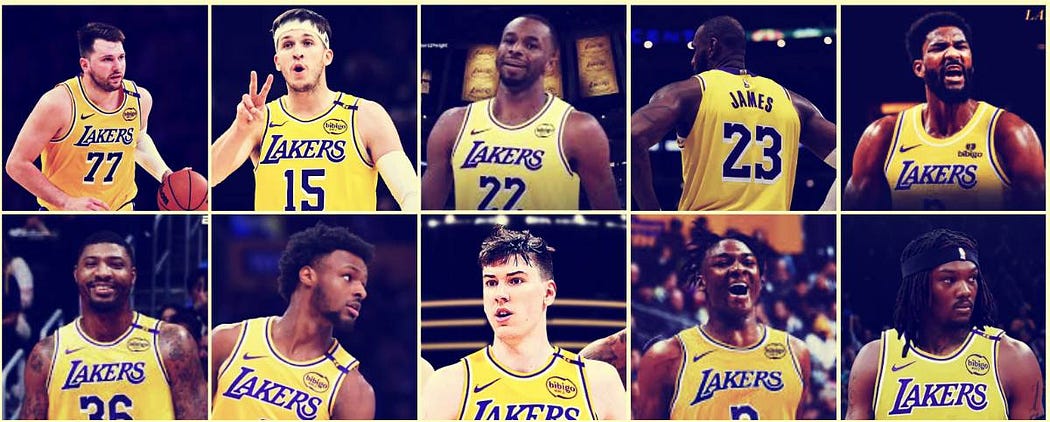
Right now, the Lakers have 8 potential rotation players: 3 starters and 1 backup from last year’s roster, 1 starter and 2 backups from this summer’s free agency and buyout markets and 1 backup from this year’s draft.
That gives the Lakers 4 projected starters in point guard Luka Doncic, shooting guard Austin Reaves, power forward LeBron James, and center De’Andre Ayton, plus one open starting role for a 3&D small forward.
The Lakers’ 4 projected backups include point guard Marcus Smart, shooting guard Bronny James, small forward Jake LaRavia, and power forward Adou Thiero, plus one open backup role for a defensive center.
The Lakers have 5 one-way players whom they’d like to swap or move, including Rui Hachimura, Gabe Vincent, and Maxi Kleber on expiring contracts and Jarred Vanderbilt and Dalton Knecht on longer term deals.
Ideally, the Lakers need to turn those $40 million in expiring contracts and $15 million in long-term contracts into a championship starting small forward like Andrew Wiggins and backup center like Robert Williams III.
Ideally, the Lakers could begin season starting Luka Doncic, Austin Reaves, Andrew Wiggins, LeBron James, and De’Andre Ayton backed up by Marcus Smart, Bronny James, Jake LaRavia, Adou Thiero, and Robert Williams.
The starting lineup would be outstanding as would Smart, LaRivia, and Williams as backups. The big questions would be whether Bronny James or Adou Thiero were good enough to step in and replace an injured starter.
Bottom line, the Lakers would be smart to go all-in on building a ‘Ten Deep’ rotation before the start of the season so they could focus on upgrading their backup shooting guard and power forward before the trade deadline.
Leave a Reply
You must be logged in to post a comment.